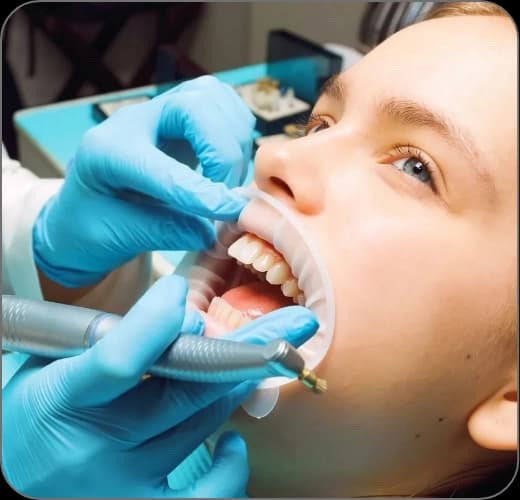
The chewing surfaces of the molars are covered with deep grooves and pits called fissures; these areas trap food debris and bacteria easily, while toothbrush bristles often cannot reach into them. Fissure sealants cover these vulnerable surfaces with a flowable filling material, aiming to prevent decay from developing. Assoc. Prof. Dr. Sezin Özer completes the treatment without any drilling, usually in a single visit.
What are fissure sealants and why are they needed?
The chewing surface of a molar is an uneven landscape of tiny valleys and ridges. These deep clefts, called fissures, provide an ideal niche for bacteria and food debris to settle in; a large share of childhood cavities begins in exactly these areas.
A fissure sealant fills these grooves with a thin, flowable protective layer, turning the surface into one that can be brushed and kept clean. Scientific studies show that fissure sealants significantly reduce the development of decay in permanent molars. What is more, when applied over decay still at the initial stage (a white spot lesion), they also have the potential to arrest its progression.
When should they be applied?
The ideal timing is the early period after the teeth erupt — in other words, before decay has had a chance to begin. For the first permanent molars this is usually around age 6, and for the second permanent molars around age 12.
The decision is made individually for every child: Assoc. Prof. Dr. Sezin Özer evaluates the eruption status of the tooth, the depth of the grooves and the child's caries risk level together. In children at high risk of decay, sealing deeply grooved primary (baby) molars may also be considered.
Which materials are used?
There are two main groups of sealant materials. Resin-based sealants bond to the tooth for longer, but they require the surface to be kept perfectly dry during application. Glass ionomer-based sealants are more tolerant of moisture and release fluoride, contributing an extra layer of protection.
The choice of material takes into account the eruption status of the tooth, whether saliva control can be achieved and how comfortably the child copes during the visit. The aim is to use, for each child, the option that will give the most predictable result.
Is the procedure hard on the child?
Fissure sealing is one of the most comfortable procedures in pediatric dentistry: no drilling is involved, anesthesia is rarely needed and the application takes only a few minutes per tooth. That makes it a gentle introduction for children experiencing a dental procedure for the first time.
Assoc. Prof. Dr. Sezin Özer works through the session with a tell-show-do approach; the child first sees each step, then experiences it. In this way the treatment not only protects the tooth but also strengthens the child's relationship of trust with the dental chair.
How long sealants last and how they are monitored
Because fissure sealants are exposed to chewing forces, they can wear down or partially chip over time. Their integrity is therefore monitored at regular check-ups, and any missing areas can be topped up in a short visit.
It is important to remember that a sealant protects only the chewing surface. For the surfaces between the teeth, daily brushing, flossing and any fluoride applications the dentist recommends remain indispensable parts of the preventive program.
The treatment, step by step
Examination and assessment
The eruption status of the molars and the depth of the grooves are examined; together with the child's caries risk level, the teeth to be sealed are decided.
Surface cleaning and isolation
The chewing surface of the tooth is cleaned and the area is isolated from saliva so that the material can bond.
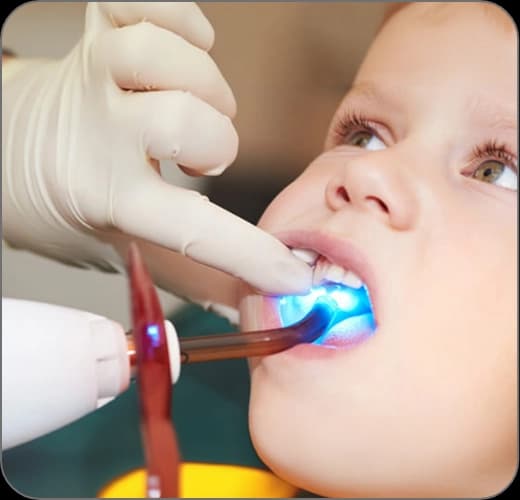
Applying the sealant
The flowable material is placed into the grooves and hardened with a special curing light; no drilling is done.
Bite check
The child's bite is checked and, if necessary, fine adjustments are made to the surface; the procedure is completed in the same visit.
Regular follow-up
The integrity of the sealant is monitored at check-up appointments; worn or missing areas are renewed when needed.