Baby teeth are nature's own space maintainers for the permanent teeth developing underneath. When a baby tooth is lost too early because of decay or trauma, the neighboring teeth begin to drift into the gap and the space for the permanent tooth narrows. A space maintainer preserves this gap to support the permanent tooth in erupting from the right place, and Assoc. Prof. Dr. Sezin Özer plans it individually for each child.
What happens when a baby tooth is lost early?
Baby teeth are not just for chewing; they contribute to speech development and hold the place of the permanent teeth to come. When a baby tooth is lost early, the neighboring teeth start to drift into the gap — in particular, the first permanent molar behind it begins to tip forward.
As a result of this drifting, the space the permanent tooth needs in order to erupt is lost: the tooth may fail to erupt and remain impacted, may erupt in the wrong position, or may crowd the other teeth. Since most of the space loss is known to occur within the first six months after the extraction, it is important to act quickly and have the situation assessed.
Is a space maintainer always necessary?
No — the decision is not made automatically after every baby tooth extraction. Assoc. Prof. Dr. Sezin Özer uses an X-ray to evaluate the developmental stage of the underlying permanent tooth, its position within the bone and its estimated eruption time.
If the permanent tooth is expected to take longer than six months to erupt, a space maintainer is usually recommended. If eruption is imminent, the appliance may not be needed; in that case the gap is simply monitored at regular check-ups.
Types of space maintainers
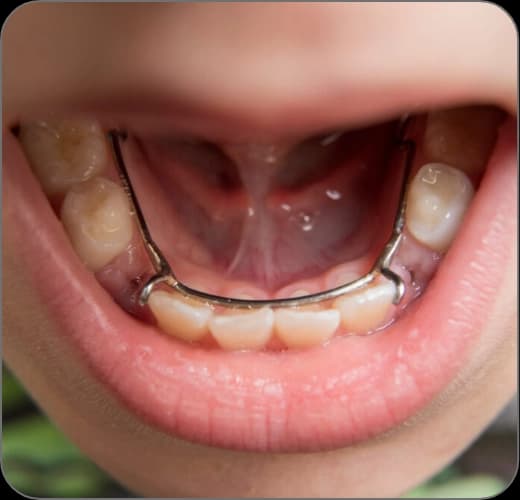
Space maintainers are made in different designs depending on the position of the missing tooth, whether the loss is on one side or both, and the situation in the jaw. The main types are:
- Band and loop: a fixed appliance used for a single missing tooth on one side
- Distal shoe: used when a second primary molar is lost before the first permanent molar has erupted
- Lower lingual holding arch: preferred for missing teeth on both sides of the lower jaw
- Nance appliance / transpalatal arch: used for missing teeth on both sides of the upper jaw
How long it is worn and how to care for it
The space maintainer stays in the mouth until the underlying permanent tooth starts to erupt; how long that takes varies with the child's development and is followed with X-rays at regular check-ups. Once the permanent tooth has broken through the gum and begun to erupt, the appliance is removed by the dentist.
While the appliance is in place, careful oral hygiene matters, and sticky foods such as chewing gum and caramel should be avoided. If the appliance loosens, breaks or starts to dig in, contact the clinic without delay; most problems can be resolved in a short visit.
The treatment, step by step
Examination and X-ray evaluation
The area of the lost tooth is examined; the position and estimated eruption time of the underlying permanent tooth are assessed on an X-ray to decide whether an appliance is needed.
Impression and design
If a space maintainer is needed, an impression of the child's mouth is taken and the type of appliance suited to the gap is custom-made in the laboratory.
Fitting the appliance
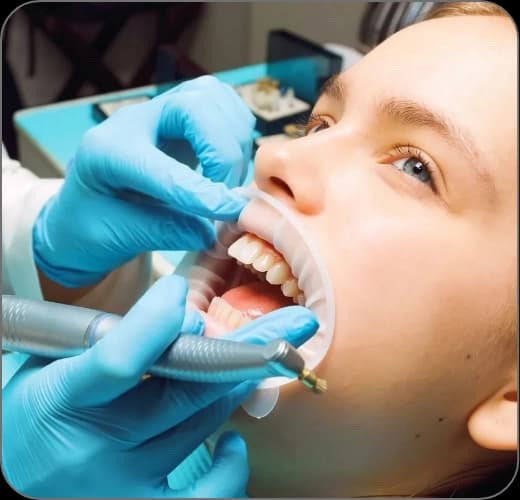
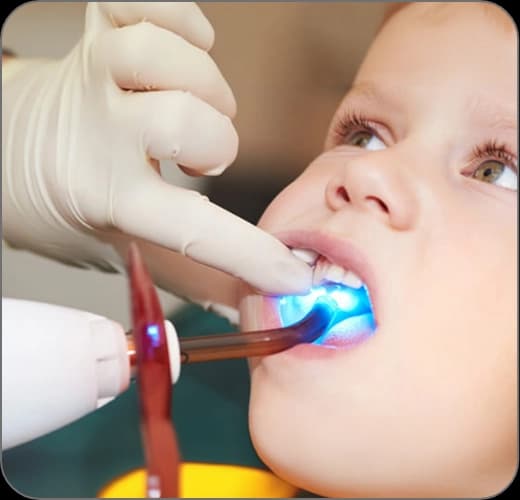
The finished space maintainer is fitted in the mouth; its fit and its relationship with the bite are checked, and the child and family are told how to look after it.
Follow-up and removal
The appliance and the development of the permanent tooth are monitored at regular check-ups; once the permanent tooth begins to erupt, the space maintainer is removed by the dentist.