Root canal treatment saves a tooth from extraction by carefully removing the inflamed or infected pulp tissue at its center, disinfecting the canals and sealing them with a leak-proof filling. Performed under local anesthesia, the procedure is comfortable for most patients, eliminates the true source of the pain and aims to keep the natural tooth in place for many years. At our clinic in Atakum, Samsun, root canal treatments for children and adults are planned with up-to-date methods.
Why Is Root Canal Treatment Needed?
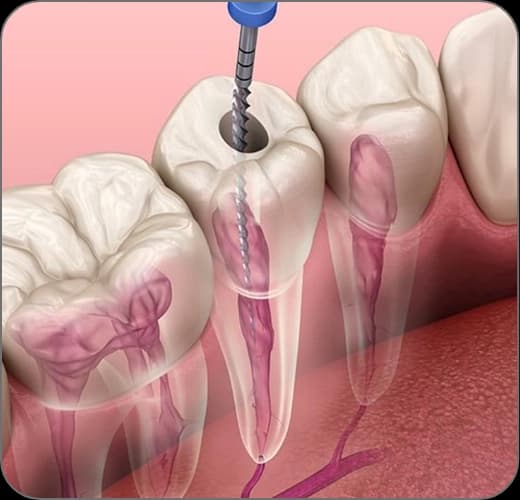
Beneath the hard enamel and dentin layers of every tooth lies a living tissue made up of blood vessels and nerves. Known as the pulp, this tissue supports the tooth's development and nourishment during youth; once the tooth has matured, it also helps perceive stimuli such as heat and cold. It is this tissue that keeps the tooth alive.
When a cavity left untreated works its way through the tooth's hard layers and reaches the pulp, this delicate tissue becomes inflamed. Because the pulp is confined within a closed space surrounded by hard walls, the resulting pressure causes throbbing pain that typically worsens at night. Without treatment the pulp loses its vitality; even if the pain subsides for a while, the root canals turn into a sheltered refuge for microbes, and the infection can advance from the root tip into the jawbone, producing the root-tip lesions (abscesses) seen on X-rays.
Antibiotics alone cannot resolve this condition, because medication carried in the bloodstream cannot reach the inside of the tooth. Treatment aimed at the source of the problem means removing the infected tissue inside the canals, disinfecting the canal system and sealing it so that microbes can no longer take hold.
- Throbbing toothache that starts on its own
- Severe pain that intensifies at night and disturbs sleep
- Lingering ache triggered by heat or cold that can last for minutes
- Sensitivity that becomes noticeable when chewing or touching the tooth
- Color change such as graying or dulling of the tooth
- Swelling of the gum or face, or a gum boil discharging pus (fistula)
How Is the Diagnosis Made?
The right treatment starts with the right diagnosis. The first step is listening to the patient: when and how the pain began, how long it lasts, the patient's general health and current medications provide the first clues. This information helps distinguish whether the complaint originates from a tooth or from another condition such as sinusitis or a jaw-joint disorder.
The second step is clinical testing. A cold test shows the vitality of the nerve and its response to inflammation; a percussion test, performed by gently tapping the tooth, reveals whether the inflammation has spread to the root tip; and palpation of the gum assesses the condition of the tissues around the root.
The final step is imaging. Small periapical X-rays provide valuable information about the roots and the surrounding bone; when needed, several films of the same tooth are taken from different angles. In complex cases that are difficult to diagnose, cone-beam computed tomography (CBCT) may be used. Imaging decisions are always guided by the principle of obtaining the most accurate information with the least radiation.
Modern Treatment Methods
Treatment begins by numbing the tooth and the surrounding tissues with local anesthesia. The tooth is then isolated from the rest of the mouth with a thin rubber sheet called a rubber dam. This prevents microbes in the saliva from seeping into the canals, keeps disinfecting solutions out of the mouth and provides a clean, dry working field.
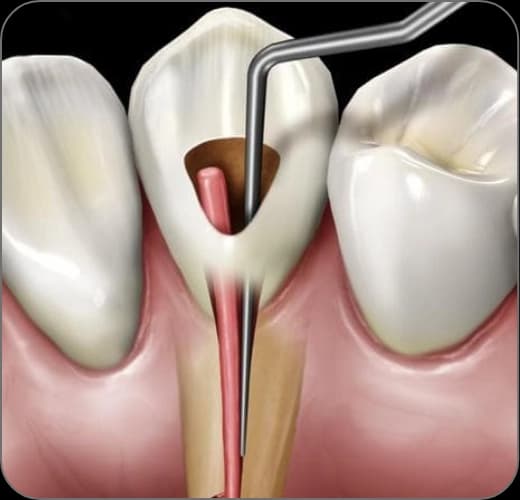
A precise access opening is made to reach the pulp chamber. Modern endodontics follows a minimally invasive principle: as much sound tooth structure as possible is preserved, because the long-term strength of the tooth depends on the amount of healthy tissue that remains. The depth to which each canal will be cleaned is measured with high precision using an electronic apex locator and is usually confirmed with a small X-ray.
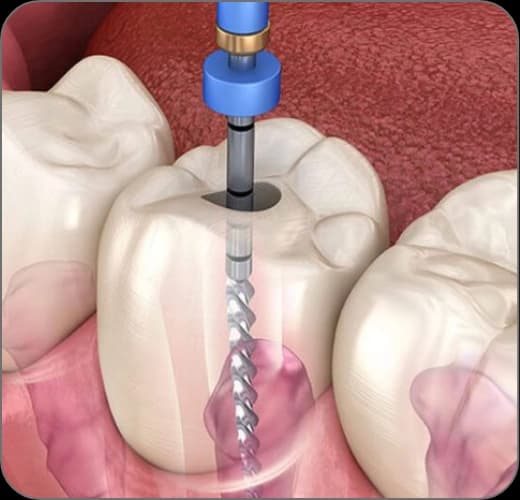
The canals are shaped mechanically with flexible nickel-titanium rotary instruments while being chemically disinfected with solutions such as sodium hypochlorite and EDTA. The two methods complement each other, and the effectiveness of the solutions can be enhanced with techniques such as ultrasonic activation.
Once cleaned and dried, the canals are sealed tightly with biocompatible gutta-percha and root canal sealer. Bioceramic sealers, which can bond chemically to tooth structure and support the formation of hard tissue, are among the recent advances in this field.
The Long Life of the Tooth After Treatment
Treatment is not complete once the canals are filled. The longevity of a root-treated tooth depends closely on the quality and timing of the permanent restoration placed on top of it. If the tooth is covered with a leaking filling, microbes can eventually reach the canals again; the permanent restoration should therefore be placed as soon as possible.
Back teeth, which bear most of the chewing forces, become more prone to fracture after root canal treatment. Protecting these teeth with restorations that fully cover their cusps, such as onlays or crowns, is recommended. Posts — popularly known as screw teeth — do not strengthen the tooth; they merely support the final restoration when too little tissue remains, and they are used only when genuinely necessary.
Regular dental check-ups and good oral hygiene are the most important part of protecting the health of a root-treated tooth.
Root Canal Treatment in Children and Young Permanent Teeth
In pediatric dentistry, the treatment decision depends on whether the tooth is a baby tooth or a permanent one. In baby teeth, rather than removing the entire nerve, vitality-preserving approaches such as pulpotomy — in which only the affected portion is cleaned away — are usually preferred.
In young permanent teeth whose roots have not yet fully formed, the priority is to preserve the vitality of the pulp so that root development can continue. Assoc. Prof. Dr. Sezin Özer carries out treatment in children using behavior guidance techniques such as tell-show-do, at a pace that respects each child; where cooperation cannot be achieved, sedation options are considered.
Root canal treatments for adult patients are planned and performed by our dentists at Dental Prime in Atakum, Samsun, based on the findings of the clinical examination.
The treatment, step by step
Examination and imaging
The pain history is reviewed; the tooth is assessed with clinical tests and X-rays, and the treatment plan is established.
Anesthesia and isolation
The tooth is numbed with local anesthesia and isolated from saliva with a rubber dam, creating a clean working field.
Cleaning the canals
A precise access opening is made into the pulp chamber; the canals are cleaned and shaped with flexible rotary instruments and disinfecting solutions.
Filling the canals
The dried canals are sealed tightly with gutta-percha and root canal sealer.
Permanent restoration
The tooth is restored with a filling or crown as soon as possible, and healing is followed with regular check-ups.