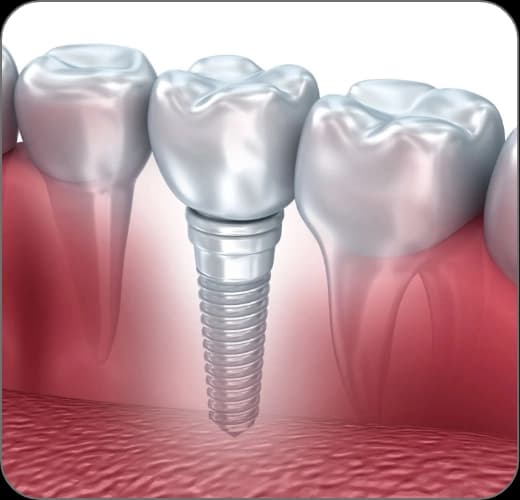
Implant treatment replaces missing teeth with artificial tooth roots placed in the jawbone that fuse with the bone over time and carry a prosthesis; it offers function and aesthetics close to a natural tooth. At our Dental Prime clinic, implant treatment is planned prosthetically driven under three-dimensional CBCT guidance and carried out by our experienced surgical team.
Who is a suitable candidate for implant treatment?
The success of implant treatment begins with the right candidate assessment. This assessment is a holistic approach covering not only the current state of the mouth, but also general health, habits and expectations. An ideal candidate is generally expected to show the following:
Conditions such as well-controlled diabetes, smoking or bone loss are treated today not as outright barriers, but as factors to be managed. Jaw growth must also be complete before implants are placed, which is why we do not rush in young patients and wait until growth is finished.
- Sufficient quantity and quality of jawbone
- Healthy, inflammation-free gums
- A suitable general health status
- Completed jaw and facial growth
- A habit of careful oral hygiene
CBCT and digital technologies in planning
The secret of a successful implant is prosthetically driven planning: first, the tooth we want to see in the mouth is designed; then the position, angle and depth within the bone of the implant that will carry that tooth in its ideal place are calculated.
A three-dimensional CBCT scan shows the height and width of the bone and its distance to important anatomical structures such as the nerve canal and the sinus cavity with millimeter precision. In cases that require it, custom surgical guides are produced from the digital plan; the implant is placed precisely at the planned spot with the help of the guide. This meticulous preparation aims to minimize the likelihood of complications and keep the process predictable.
When bone is insufficient: grafting and sinus lifting
Bone that no longer receives stimulation after a tooth extraction resorbs over time; in areas that have been toothless for a long while, there may not be enough volume left for an implant. This does not mean an implant is out of reach.
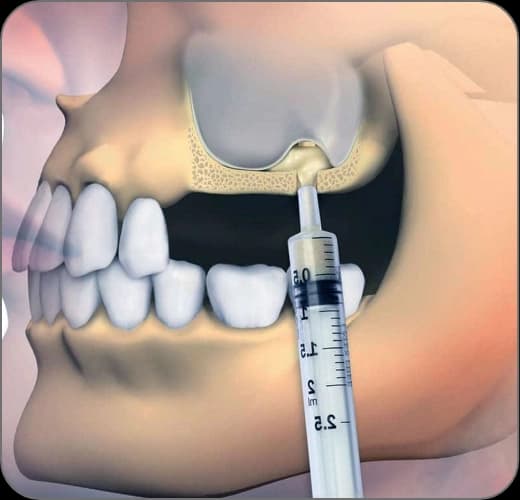
Missing bone can be rebuilt with techniques such as bone grafting and guided bone regeneration. Where vertical bone height is lacking in the back of the upper jaw, a sinus floor elevation (sinus lifting) is performed to prepare a solid base for the implant. These preparatory procedures can extend the treatment time, but they let the implant sit on a solid foundation and contribute to long-term success.
Titanium and zirconia implants
Titanium has been regarded as the gold standard of implant treatment for more than fifty years: it is biologically compatible with the body, fuses with the bone (osseointegration) and is extremely resistant to chewing forces. Its only aesthetic limitation is that in patients with very thin gums its grey color can show through slightly in the front region.
Zirconia, on the other hand, is a tooth-colored, metal-free high-tech ceramic; it is a strong alternative for patients with metal sensitivities and in the front region where aesthetics come to the fore. Which material is appropriate is determined by weighing the site, the bone structure, the chewing forces and the aesthetic expectations together.
Healing, osseointegration and implant care
Once the implant is placed, the process of fusing with the bone (osseointegration) begins. This biological process varies with bone quality and location, but generally takes 2-3 months in the lower jaw and 3-6 months in the upper jaw; in suitable cases, earlier loading protocols can also be considered.
Implants do not decay; however, the gum and bone around them can become inflamed due to bacterial plaque (peri-implantitis). Meticulous daily oral care — cleaning with interdental brushes and implant-specific floss — together with regular dental check-ups therefore forms the foundation of an implant's long life. Well-maintained implants can be used without problems for many years.
The treatment, step by step
Examination and three-dimensional imaging
Oral and general health are assessed; a CBCT scan measures the volume and quality of the bone and its anatomical neighbors.
Prosthetically driven treatment plan
Planning works backwards from the intended tooth; grafting or sinus lifting is added to the program if needed.
Surgical placement of the implant
Under local anesthesia, the implant is placed precisely in the planned position; a single implant usually takes between half an hour and an hour.
Fusion with the bone
The implant is left to integrate with the bone; the time varies with bone structure, usually between 2 and 6 months.
Prosthetic phase
Once integration is confirmed, an impression is taken and the custom-made porcelain tooth is fixed onto the implant.