Our priority is always to save the tooth; however, when a tooth cannot be rescued because of advanced decay, fracture or gum disease, extraction can be the right step for oral health. At our Dental Prime clinic, the decision to extract is made only after all alternatives have been considered; in children, primary tooth extraction is handled with a pediatric dentistry approach — with patience and compassion.
When does tooth extraction come into question?
In modern dentistry, extraction is the last resort; a tooth that can be saved with a filling, root canal treatment or gum treatment is not extracted. Extraction is planned when the tooth can no longer be kept in the mouth in a healthy state:
- Decay and loss of tooth structure too advanced to restore with a filling or root canal treatment
- Fractures at root level or extending below the gum line
- Loss of supporting bone and loosening due to advanced gum disease
- Foci of infection that do not respond to treatment
- When the orthodontic treatment plan requires extraction to gain space
Primary tooth extraction in children
As a pediatric dentist (Assoc. Prof. Dr. Sezin Özer), I try to keep primary teeth in the mouth until their natural time to fall out, because besides chewing and speech, primary teeth are natural space maintainers that hold the place of the permanent tooth coming in underneath.
Even so, deep decay, an abscess that does not respond to treatment or trauma damage beyond repair can make the extraction of a primary tooth necessary. When needed, I plan a space maintainer for the gap left by an early-extracted primary tooth; this aims to keep the neighboring teeth from tipping into the space and to prevent crowding that could develop later. Conducting the extraction visit in language suited to the child's age, without frightening them and by earning their trust, matters to me as much as the procedure itself.
Deciding on extraction after trauma
After falls and blows, teeth may fracture, be displaced or be knocked out completely. Not every traumatized tooth is extracted; many teeth can be saved by repositioning, splinting or root canal treatment. The decision is therefore made not in haste, but based on the examination and X-ray findings.
In primary tooth trauma, my priority is to protect the permanent tooth germ developing in the jaw. While a primary tooth that has been severely displaced and is pressing on the permanent tooth germ may need to be extracted, many traumatized primary teeth are simply monitored with regular follow-up. Coming in for an examination as soon as possible after trauma is extremely valuable for making the right decision in time.
How is the extraction performed?
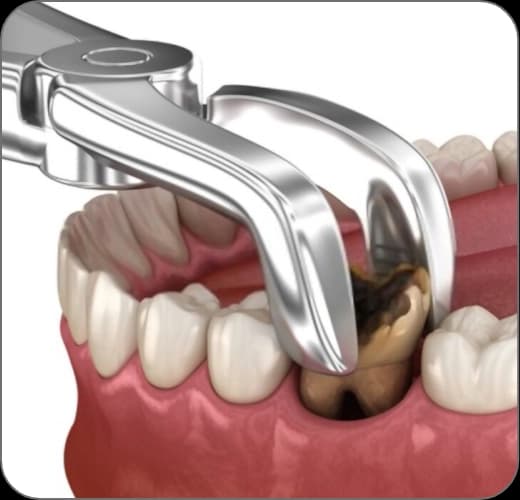
Before the extraction, the area is fully numbed with local anesthesia; the aim is for no pain to be felt during the procedure — only a feeling of pressure may remain. Most erupted teeth are removed quickly with a simple extraction.
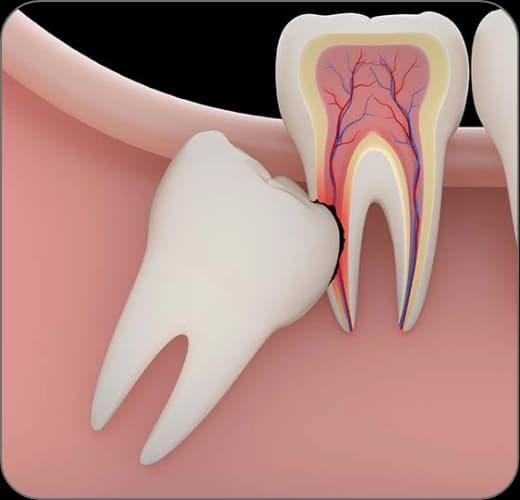
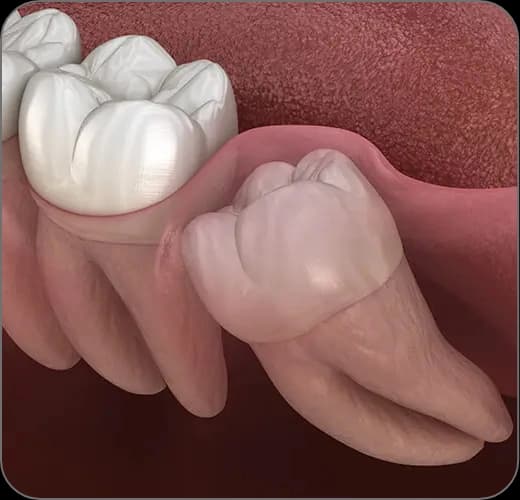
Teeth fractured at root level, teeth with curved roots or teeth trapped within the bone may require a minor surgical approach. In both cases the goal is to remove the tooth gently while preserving as much of the surrounding bone and gum as possible; the preserved bone is also a valuable foundation for a possible future implant.
Aftercare and the future of the gap
The blood clot that forms in the extraction socket is the foundation of healing. Because losing the clot early can lead to a painful condition called dry socket (alveolitis), spitting, using straws, hot foods and smoking should be avoided in the first days.
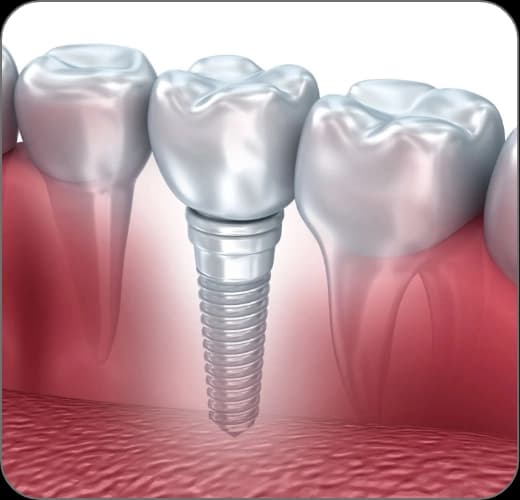
In adults, when an extraction gap is left empty for a long time, the bone in the area starts to resorb and the neighboring teeth begin to tip into the space. That is why considering options such as implants and bridges at the right time after an extraction — and planning a space maintainer for children where needed — matters for long-term oral health.
The treatment, step by step
Examination and X-ray
The tooth's condition is assessed with a clinical examination and an X-ray; the root anatomy and neighboring tissues are studied.
Considering the alternatives
The chances of saving the tooth with a filling, root canal treatment or gum treatment are reviewed; extraction is planned as the last resort.
Local anesthesia and extraction
The area is fully numbed; the tooth is removed gently while the surrounding tissues are protected.
Gauze pad and recovery guidance
A gauze pad is applied to control bleeding; advice on protecting the clot and on diet is explained.
Planning for the gap
A space maintainer for children where needed, and implant or prosthetic options for adults, are considered at the right time.