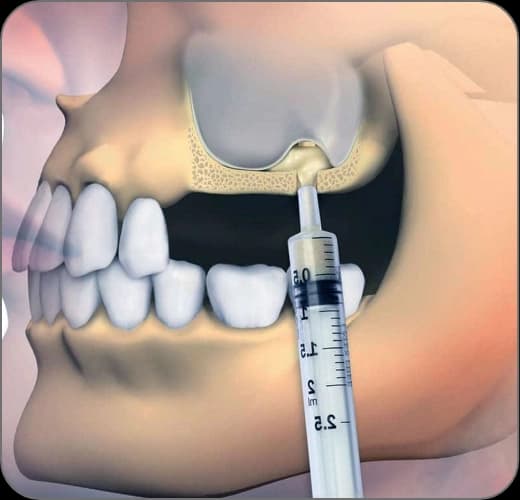
The back of the upper jaw borders the maxillary sinus cavities that sit just above the roots of the molars; after tooth loss the sinus sags downwards, the bone resorbs and there may not be enough vertical distance left for an implant. Sinus lifting gently raises the sinus membrane and places a bone graft into the space created to prepare a base for the implant; at our Dental Prime clinic it is planned under CBCT guidance.
Why is sinus lifting needed?
After a tooth is extracted in the upper jaw, two processes advance together: the bone in the area starts to resorb because it no longer receives stimulation, and the sinus cavity expands downwards. When these two combine, there may not be enough vertical bone height left to carry an implant safely.
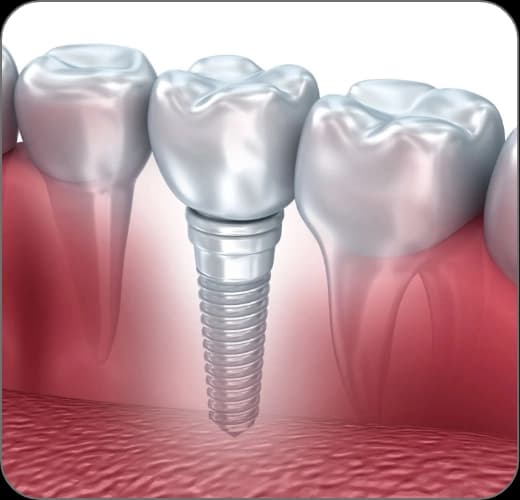
An implant placed into insufficient bone cannot find the retention it needs. Sinus lifting can be compared to raising the ceiling of a low-ceilinged room: the sinus membrane is delicately lifted upwards, and a bone graft placed into the resulting space creates a new volume of bone for the implant.
Open and closed technique
Sinus lifting can be performed with two different techniques. When a larger volume of bone is required, the open technique is preferred: a small window is opened in the lateral wall of the sinus, the membrane is lifted over a wide area and the graft is placed.
In cases needing less bone, the closed technique is used, working through the socket prepared for the implant. This method is less invasive and is usually carried out in the same session as implant placement. Which technique is appropriate is determined by the existing bone height measured on the CBCT scan.
The operation and the healing period
The procedure is carried out comfortably under local anesthesia. If the existing bone height is enough for the implant's initial stability, sinus lifting and implant placement can be done in the same session; if it is insufficient, the graft is first left to mature and the implant is placed in a second stage.
The maturation of the added bone varies from case to case but usually takes 6-9 months. At the end of this period the area is reassessed and the implants are placed with confidence.
What to watch out for after the operation
Movements that create pressure changes in the sinus area can strain the healing membrane and the graft. For the first weeks after the operation you will therefore be asked to follow these rules:
- Avoid blowing your nose; wipe any nasal discharge gently
- If you need to sneeze, sneeze with your mouth open
- Do not use a straw, inflate balloons or play wind instruments
- Consult your dentist before activities involving pressure changes, such as air travel or diving
- Do not smoke; take the recommended medication regularly
The treatment, step by step
CBCT assessment
The borders of the sinus cavity and the existing bone height are measured with millimeter precision using three-dimensional imaging.
Technique selection and planning
The open or closed technique is chosen according to the bone required; the possibility of simultaneous implant placement is evaluated.
The operation
Under local anesthesia the sinus membrane is gently lifted and a bone graft is placed into the space created.
Graft maturation
The added bone is left to mature; this period varies by case, usually between 6 and 9 months.
Implant phase
Once sufficient bone volume has formed, the implants are placed in their planned positions.